Thursday, February 25, 2021

My Life in Chairs

“Don’t even go there!” my back admonishes me.  
It must have seen me eyeing my cozy nestle chair by the garden doors, novel in hand, and is having none of it.
  Better heed its warning.  Looks like a chair isn’t an option for me just yet.  The price to pay in back agony and leg pain is just too high.  More yoga, more stretches, more massage, more exercise.  Then, maybe?  Until that moment, the floor awaits. How ironic, that my life, traced in an astonishing variety of chairs, is now defined by a lack of one. 
 Cushioned against the couch on the floor, a bolster under my knees, cup of tea in hand, I am engrossed in a slide show of the chairs that have defined my life. 


My first official chair, a kitchen stool with a seat and back in soft grey and white swirls and retractable steps, found its higher purpose as a high chair.  My father added a tray, and, later, a hook, so that I couldn’t push it over my head and dump the contents, either by accident or on purpose.   Next came the wooden toddler chairs with matching table, a gift from parents on my first birthday.   My paternal grandparents added a matching rocking chair,  the blue cat decal scratched and faded with the years, an ID label under the seat in my mother’s characteristic hand. Now, my grandsons rock out in it when they visit.


The chairs of my youth were developmental chairs.  On the grey kitchen chairs, I learned to play cribbage.  On the desk chair in my Grade 5 classroom, I heard that John F. Kennedy had been assassinated. Glued to the den desk chair with the fluorescent green seat and dark brown half-back at age twelve, I taught myself to type using the QWERTY keyboard on a small blue typewriter my father obtained as a premium from an encyclopedia purchase.  On the fluorescent blue wooden chair in my room, I puzzled through algebra and trigonometry, and recited French verbs conjugations.  On the piano bench, I practiced scales and pieces and prepared for exams, building a skill whose impact on my life I could never have imagined when I was thirteen.


The adult chairs marked milestones.  The blue swivel rocker and the Bentwood rocker where I nursed my babies; the blue vinyl kitchen chairs where the children did crafts and my parents played bridge; the formal dining room chairs around a long, oval cherry table, witness to three generations of birthdays, anniversaries, holiday gatherings, graduations, and, yes, bereavements. 


For challenge and growth, the professional chairs led the way.  The black swivel business chair of my home office took care of the hidden, ubiquitous work of teaching,  the  late-night lesson preparation and feedback on student work.  Its twin in various classrooms and offices throughout the decades handled the conferences, the record keeping, and lots of planning.   From the professional chairs, the chairpersons  of meetings and professional development sessions over the years,  I learned the art of facilitation:  how to interact with participants, create a buzz in a room, effect smooth transitions from one activity to another, involve participants in active learning and conversation irrespective of the number of attendees.  The relative skill of chairpersons allowed me to maximize my tool kit, or conversely, imagine what could be done differently.


Mrs. Macquarie's Chair in a torrential
downpour, Sydney, AU Jan 2020
Ah, memories from the vacation chairs:  the deck chairs on cruise ships where I read and made new friends; two prized resort beach chairs scavenged from a wasteland of lounge chairs bereft of people but boasting a towel as the mark of proprietorship; an oversized bright pink easy chair on the streets of Mesa, Arizona, begging for a photo op; the giant Adirondack chairs on the crest of the Cypress Hills inviting visitors to stop, take a break, bask in the breathtaking barrenness; Mrs. Macquarie's

chair carved into the peninsula in Sydney Harbour, risky in a torrential downpour.


Those vacation chairs belong to a past that’s paradoxically recent yet distant, real but tinged with mirage.  Now, we think of COVID chairs, physically distanced,  two metres apart.


Lost in contemplation, my thoughts turn dark, to the chairs that might lurk in my future.    The walker/chair (rollator) or wheelchair or geri-chair.  Yikes!  These I hope to avoid.  Right now,  I count on progress to a dining room chair or even my desk chair.  No rush.  Better to heal well than risk further injury.  After all, that’s why, having heard my back loud and clear, I’m on the floor.


First shared with a writing group to which I belong on November 18, 2020.  

And yes, I'm off the floor and back in hard chairs, Working toward sofas and nestle chairs.


Friday, January 29, 2021

Reads 2020


Each year since I began this blog (except 2019 when both personal reading and writing played second fiddle to full-time teaching and a trip), I’ve posted a list of my reading highlights.  Covid did and does offer lots of time for reading.  Here are the highlights, fiction first, as it insulated me somewhat from what sometimes seemed like my masochistic consumption of news and news analysis in all its forms.

Fiction


To my surprise, perusing the highlights roster, these books share a theme.  The characters manage trauma that manifests differently both in its nature and in its consequences.  How fascinating, that, in a year replete with crises, random novels would ask how human beings deal with unexpected challenges or, even more aptly, insidious life events that infiltrate bit by bit, and manifest suddenly to threaten the very soul of these proverbial frogs in boiling water.


Il pleuvait des oiseaux (And the Birds Rained Down) de Joceylne Saucier.  

Top fiction read, and it’s not even close.  Strange, maybe, because I first came across this work as a film.  Each managing his own unique trauma, three men have chosen to live a hermit life deep in the forest of northern Québec.  Their idyllic life is upended when two women, each with her own reality, interrupt their routine.  This film / book provides a unique insight into the impact of trauma in its different forms.  Even more significant for me, as I age, it shows that, whether or not they ever existed at all for people in their youth and maturity, joy, love, and fulfillment can not only exist for the first time in old age, they can surpass anything life might have offered before.  Check out the trailer in French here and in English here.  I saw the film, and just had to buy the book.


In the same vein, the next books are inspirational stories of survival in diverse situations, none of which the main character could anticipate.

·      A Town Like Alice by Nevil Shute, a perennial favorite since I stumbled on it in high school, and which I purchased in Alice Springs itself during a visit to Australia just before Covid a year ago.  Jean, a young typist working in Malaya in the late 1930’s, emerges as a leader when the Japanese army takes a group of British women prisoner and sends them on a forced march across the country.  Patience—the story begins after the war, and flashes back as it moves forward.  Heads-up—the narrator’s life mirrors that of a few of the characters in Il pleuvait des oiseaux.

·      The Great Alone by Kristin Hannah and

·      My Abandonment by Peter Rock (check out the film version, Leave No Trace; trailer here), two stories of the effects of lifestyle choice on people in one’s bubble and the decisions those people are forced to make in the wake of those choices.  Very compelling both, if disturbing in parts.


·      A Heart in the Body in the World, by Deb Caletti, one of the best novels I’ve read.  This story tells a difficult and timely story within a sophisticated and effective structure. Best not to include any details at all, for fear of giving away anything that might detract from the reading experience.  I couldn’t put the book down.  I also read a few more of Caletti’s books:  Wild Roses and The Secrets She Keeps, both good reads but not in the same league as A Heart in the Body in the World.


For light(er) fare, you might enjoy

·      The Gown by Jennifer Robson, a story of one of the seamstresses who crafted Princess Elizabeth’s wedding gown (available on Hoopla);

·      The Woman in the Window by A.J. Finn, a psychological thriller that will keep you turning the page.  Check out the trailer for the recently released film. 

·      La bonne de Chagall by Karen Olsen.  Based on the decisions of a woman who worked for the artist Chagall, this novel is written by a former French consultant for Regina Public Schools.


Non-Fiction


For those of you, like me, who have absorbed the distressing political reports along with the Covid bulletins, these reads might entice you.  They illuminated my understanding of issues in our world.  Ah-ha moments on every page.

·      Caste: The Origins of Our Discontent (2020), by Isabel Wilkerson, whose thesis is that racism is at the core of the polarization in the United States.  She explores this idea by comparing and contrasting race in India, Nazi Germany, and the United States, with astounding conclusions.  A startling statement at the end of her book presages the January 6 assault on the US Capitol.  She quotes Taylor Branch, a historian of the civil rights movement: “‘If people were given the choice between democracy and whiteness, how many would choose whiteness?’” (p. 352).  For me, this book was a page-turner.

·      The Jakarta Method: Washington’s Anticommunist Crusade & the Mass Murder Program that Shaped Our World (2020), by Vincent Bevins.  I stumbled on an essay version of this book quite by accident while preparing a unit on the Cold War.  I ordered the book immediately.  If you’ve ever wondered about the extent of American involvement in the politics of other nations, this book will strip any illusions you may ever have had.  It left me horrified.  Bevins says that the story is for “people who want to know how violence and the war against communism intimately shaped our lives today.” (p. 3)

·      Shrewed:  A Wry and Closely Observed Look at the Lives of Women and Girls (2018) by Elizabeth Renzetti.  Funny and insightful, this is a book I could have used forty years ago.  It spoke to me in its irreverence and unsparing honesty.  “It’s in the chaos that we find ourselves,” Renzetti says (p. 143), and my senior head nods in agreement.


Happy reading.  I would enjoy any comments on any of these books, at any time, as well as suggestions to enhance my own 2021 reading life.

Wednesday, December 30, 2020

My Covid Christmas

  
“That’s when my life will start,” the waiter says to me, in response to my query about his current projects besides working in a restaurant. 
He’s going to apprentice next year, he says, and then his life will begin.  

“Your life is happening right now,” I can’t help but interject.  The mother and the teacher in me are engrained, always there.  “You know what they say about life—it’s what happens when you’re making other plans.  Your life is your experience in the restaurant when you’re here, right now, and outside with your friends and family.  It’s what happens later, when you apprentice, as well.”   Chalk it up to age, experience, inspiration from people I know, all of the above.  I have learned to cherish every moment of my life, even in the darkness.  Rejoice on a Monday, celebrate Wednesday, be as happy on a Tuesday as on a Saturday.  Be happy when we must wear a mask and when we can go without.   Find the jewels in the rough. 


That might be why I’m astonished when I hear people say about this Covid Christmas that they’ll celebrate next year.   Next year is uncertain at the best of times, and, in the elongated days and months of the pandemic, when circumstances change from minute to minute, it has never been more important to live in the moment.  We can’t afford to write off Christmas 2020, despite the sacrifices, and bank on gathering with family and friends next year.  What has that looked like for me?


It didn’t mean flouting the public health protocols and getting together across provinces, eleven of us under one roof.  Christmas was a quiet affair at our house, just my husband and me.  No massive food preparation, no choir practices, no high chairs or toy boxes or eleven chairs around a dining room table in maximum extension.  No conversations around social issues late into the night, no board games, no taking the grandkids tobogganing or pulling the sleigh to the park.  This year, the in-law year for Christmas, any Christmas hubbub would occur now, in the laconic, surreal days between Christmas and New Year.  But not this year.  


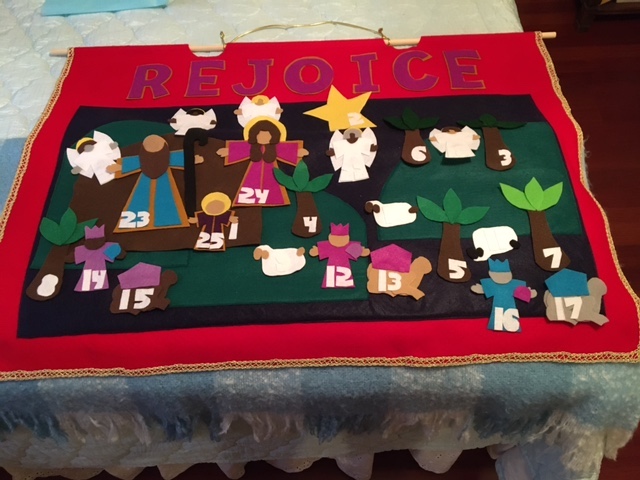
Yet Christmas 2020 has presented a myriad of precious occasions to broaden the holiday experience.   In a “normal” year, would our grandson and our niece have texted to discuss the optimal placement of a figure on the Advent calendar they both have, about which you might have read in an earlier post.  That calendar also focused December for our grandchildren, and might even have liberated their parents to direct energy into adding to their own holiday traditions rather than in answering repetitive questions about when Christmas was coming.  


In a “normal” year, our neighbour would have headed south, and we would have missed Happy Hours and meals with her, and celebrations of milestones in both our lives.  


In a “normal” year, would my husband and I have had time to prepare harp-accordion duets for the Christmas liturgies?  Would there even have been time for those duets during the liturgy, given the critical role of congregational singing in liturgical celebrations?   


In a “normal” year, obsessed with a clean house and a packed freezer, would I have recorded The Velveteen Rabbit in eight short chapter videos for the grandkids?  Would I have taken the time to post a few Christmas carols on the harp?  My musicianship developed so much as a result of the recording experience.


In a “normal” year, we would have celebrated réveillon after the last Christmas Eve mass, as well as Christmas Day supper, with others.  This year, we connected with any available children on Zoom on both occasions. Although we were in different locations and enjoying different delicacies, our conversation and the immediacy of togetherness transferred online.


In a “normal” year, we would have celebrated our daughter’s Christmas birthday a few days later, with singing in the birthday trifle at home.  Instead, we were invited into their home through FaceTime to sing in the birthday trifle our daughter and her family had made and assembled together.


In the end, we did celebrate both the essence and the reality of Christmas.   The phone calls, emails, texts, video connections and restricted church gatherings manifested the caring spirit of the holidays.  So too the hand cut-outs of our grandson and his sister that hang on the doorframe, and the first-annual(?) Zoom family games night.   We just can’t afford to sacrifice celebrations because they must diverge from habit and tradition.  Even when things are “normal”, we can’t count on next year, on next month, not even on tomorrow.  Life happens every minute, not at a particular moment that matches a preconceived idea or dream.  As our son has reminded us in a shared article, we don’t know when we are doing something for the last time. Best, then, for the young waiter and for us, to maximize every single moment.  Even when it doesn’t seem logical or possible or even desirable.


Tuesday, December 15, 2020

The RK Sushi Experi-ment/ence

When I heard that Rice Krispie sushi could be a thing, or was a thing, I thought of the delight in my grandkids’ eyes when they would
see it. Just three ingredients—Fruit Roll-Up, Rice Krispie cake mixture, and a gummy worm centre. This idea is not original—let’s dispel any rumours of creativity—but I can’t remember where I first saw it or who might have mentioned the possibility. I checked online for tips on the process. Okay, not exhaustively. Still, the results weren’t encouraging—the closest anyone came to my vision was a Rice Krispie cake rolled around gummy worms that stretched along one edge, like a jelly roll, then cut in bite-sized sushi pieces, only then to be wrapped in a length of Fruit By The Foot.

 Not good enough. I wanted an authentic roll-up experience, with the Fruit Roll-Up integrated into the “sushi” roll. With no process to follow, I decided to trust my ideas, and to rely on the accumulated wisdom of more than forty years of experience with food. I wasn’t discounting, either, the knowledge gleaned from Food Network. With Rice Krispies languishing on the counter in the downstairs kitchen, marshmallows leftover from summer camping propped beside them, the reminders were omnipresent, if not all the raw materials. 

It seems audacious to say that the planets aligned for Rice Krispie sushi-roll making. Given the pandemic and the political chaos south of the border, the metaphor seems too grand. Let’s say instead that the tumblers fell together at the grocery story (logical) in the transformed bulk bin aisle (unexpected). As I searched for almonds, bags of gummy worms beckoned at eye level. Well. It was a sign. Next, the Fruit Roll-Ups. They still do exist, both in sheets and by the foot. I wasn’t sure, so much time having elapsed since I used to buy the strips to teach simple, compound, and complex sentences to middle years students. Time to head to the til. 

The biggest, challenge, I imagined, was keeping the Rice Krispie batter malleable enough to spread on a sheet of fruit roll-up. What about working on my warming tray covered with parchment paper? 
I would also keep the equipment and materials at the ready: a flat spatula, a cake server, a spoon, and a knife in a tall glass of water; the gummy worms; and the sushi rolls still in the wrapper with the top snipped. Further down that kitchen counter, parchment paper on a cookie sheet would act as the receiving blanket for the newborn sushi rolls. With everything in place, I prepared the Rice Krispie cake and prepared to work as quickly as I could. 

With the Rice Krispie mixture on the stove in stasis on low, I began. Warming tray set on low too, I unwrapped a sheet of Fruit Roll-Up on the parchment paper. As I began to spread some Rice Krispie mixture on top, the Fruit Roll-up sheet disintegrated in the heat. Warming tray maybe not such a good idea. The flopped roll was good, though. Gummy worms are one of my guilty pleasures.

 Round 2. This time, I spread the fruit roll-up sheet directly on the parchment. I spread the Rice Krispie mixture on top with a wet spoon to prevent sticking, and flattened it with the wet cake server. When the sheet was mostly covered, I stretched out a gummy worm (one gummy worm, stretched a little, was perfect), and began to roll with the parchment as leverage. The result: a reasonable looking sushi roll. Still using the parchment paper, I massaged the sushi roll, and molded it to a more streamlined shape. It took its place on the incubator.

Round 3. I was on a roll now. Same procedure, but this time, I used the cake server to flatten the cake mixture as much as I could, much like one would pound a chicken breast or pork cutlet to make schnitzel. Rolling up was much easier this time, and the appearance of the final product had improved dramatically.

My takeaways from this process: 
Fun project! 
Parchment paper is the secret weapon. Nothing sticks. 
I didn’t have to work quite as fast as I had first thought. The Rice Krispie mixture did stay soft in the pan. There was some caramelization, though, of the marshmallow as a result of the prolonged heat, even on low. The cake I made with the leftover mixture had a much deeper flavor than usual. Next time, I might try a hot water bath. The sushi rolls are extremely sweet. One bite goes a very long way. Delicious, though, and soft enough to chew easily. 
I made only five rolls, counting one failed attempt. Two I sliced for the taste test and photo. Two are in the freezer. In the end, the experiment resulted in a delightful experience. Interesting, isn’t it, that both these words, experiment and experience, originate in the same Latin root: "they both come from the word experior, which means, to gain knowledge through repeated trials." To gain knowledge from trying over and over again. In fact, the French word for experiment is indeed expérience! So, in every sense of the word, my experiment did indeed culminate in a satisfying and delicious experience!


 For more information on the etymology of experience and experiment, see Kyle Kowalski and a podcast by Dr. Andrew Weil.

Tuesday, November 17, 2020

Channeling Maman

Maman and I circa 1985
 My sister and I sit on opposite sides of a long white collapsible table, scissors in hand, swatches of felt in vivid red, navy blue, peacock blue, dark and light greens, and white to our left, patterns, pins, rulers to our right. As we cut the pieces that will later coalesce into figures for three Advent calendars, we chat.  In our adulthood, our collaborations have been limited to celebrations for our parents.  Here we are, though, a retirement-enabled pair enshrining the Christmas story in fabric for our children and grandchildren.  This is my sister’s second go-round.  I am the beneficiary of her careful replication in triplicate last year of her own Advent calendar purchased at a craft show decades before. So here I am, a grateful recipient of an invitation not only to join her in another crafting session this fall, but also to piggy back on her patterns and experience.  Two of the calendars will be mine.

Pieces awaiting assembly

As we cut, count, sort and glue, we swap memories.   Maman creating wedding decorations, knitting Christmas stockings, drawing posters for the church bazaar, making quilts for her grandchildren, or fashioning a Japanese geisha wig from wool, Christmas garland and a ball from roll-on deodorant. Maman, the incomparable seamstress, at her machine.   Watching her, amazed, miter corners, insert sleeves without even a hint of a gathe
r, or make perfect bound buttonholes. Listening to her explain the process as she worked, and share childhood stories and snippets of her own life as a career woman in the forties.  Asking questions, 

prompting her for more, 

filing away the lore and the wisdom.

Angel pieces


All the while, I channel my mother so intensely,  I sense she’s sitting beside me.

I’ve channeled Maman often since she left us, eleven years on November 19, at the age of 92.    She reminds me that my crêpes stick because my pan isn’t hot enough. She nudges me to use the “good” dishes, with the bread and butter plates, even if it’s just my husband and me for Sunday dinner.  Oh, and to remember that the knife blades turn inward, toward the plate. I hear her pull from her vast collection of aphorisms:  « Dis-moi qui tu fréquentes, et je te dirai qui tu es » (If I know who your friends are, I know who you are.); “What’s worth doing is worth doing well”; « Quand on crache en l’air, ça nous retombe sur le nez » (Anything you spit up in the air will land on your own nose.).  I catch myself saying to my grandchildren when they visit, “Thank you for coming to see Mémère,” just as she used to say to our children.  


Gluing process
I recall her meticulous attention to detail as my sister and I work on
the Advent calendars.  I haven’t sewn since I made my daughter’s dance costumes, seven of them, in 2002. The hems, repairs, and buttons I’ve tackled since hardly qualify as “sewing.”    So I’m a little nervous.  The underside has to be as pretty as the outside (Steve Jobs had nothing on Maman): seams straight, threads tied, no bunching, everything tidy.  With her watching me, I measure several times before I cut.  I work slowly.  I protect the surfaces of the table and any other fabric when I glue.  I want to live up to her standards. 


Figures done
The work advances methodically.  We meet our daily objectives.  Day 1 we shop and cut.  Day 2 we glue.  Day 3 we measure and sew the background, and affix the letters.  Day 4, all there’s left is the doweling, the cord, and the packing.  Done, and ahead of schedule.  Maman would be proud, I think.   I am relieved.  Despite the decades since I’ve done anything like this, I have managed to avoid a calamitous error.  The background and the figures look wonderful.


“I love it,” my grandson says, a few days later, after we unroll the calendar and he places the figures,
starting with #1, the stable, and ending with #25, Baby Jesus.  As the star, the palm trees, the sheep, the magi and their camels, the angels, Joseph and then Mary take their place on the landscape while I narrate, I realize that he’s represented the Christmas story through this calendar. I tell Maman that her legacy lives on in our children’s love of reading, in their articulate speech, in the recipes handed down, and in the love they have for the town where I grew up.  Now, for her great-grandchildren, my grandchildren, that legacy perpetuates in this calendar, something she did through me.


Wednesday, September 30, 2020

Words That Stick

These days,  I feel I’m in a tug of war between my life bubble on one side, and national and international events on the other.  The knot slips to one side of the elusive middle line, and then to the other.  My goal is to maintain myself squarely on the centre line, equidistant from both polarities.  How to enhance the lives of people I know and love, in even the smallest way, andat the same time keep my eye on the wider world picture?  Honestly, I’m not sure.

For now, my energy focuses on understanding.  I read a lot in general, much of it provocative, maybe even esoteric, in some circles.  Gems abound in those pages, gems that can be shared.  That might be one contribution to the health of the community.  Ideas.  And different ideas.   For people to read, consider, and integrate (or not).  Not just  “ words, words, words, ” empty, thoughtless and insincere, that provoked that response from Hamlet to his so-called university friends, Rosencrantz and Guildenstern.  But perceptive, insightful comments and stark conclusions from thorough, well-documented and clear journalists and authors.  Words that stick.


Here are a few quotations from my recent explorations.  All the books are fabulous and life-changing, should you want to dig into the actual document.


Ryan Holiday, in Conspiracy:  Peter Thiel, Hulk Hogan, Gawker, and the Anatomy of Intrigue(2018, p. 294), reminds us of our duty as citizens.


"If you want to have a different world, it is on you to make it so. It will not be easy to do it—it may even require things that you are reluctant to consider.  It always has.  Moreover, that is your obligation if you are called to a higher task.  To to what it takes, to see it through."


Jennifer Walsh, in The Return of History: Conflict, Migration, and Geopolitics in the Twenty-First Century( 2016, p. 297), analyzes threats facing the world as we knew it.


"If we want that deeper transformation, we have to initiate it ourselves.  This is what the history of the twentieth century revealed: individuals stepping up to draw attention to injustice, to demand greater equality of participation, and to stand up for fairness.  And they did so knowing that their demands would likely involve some personal sacrifice."


Isabel Wilkerson  in Caste: The Origins of Our Discontents (2020,  p. 16) has created a enlightening analogy to explain why citizens in the 21st century are bound to promises made to indigenous peoples and people of colour and travesties inflicted on those populations centuries before.


"We in the developed world are like homeowners who inherited a house on a piece of land that is beautiful on the outside, but whose soil is unstable loam and rock, heaving and contracting over generations, cracks patched but the deeper ruptures waved away for decades, centuries even.  Many people rightly say, “I had nothing to do with how this all started.  I have nothing to do with the sins of the past.  My ancestors never attacked indigenous people, never owned slaves.”  And yes.  Not one of us was there when this house was built.  Our immediate ancestors may have had nothing to do with it, but here we are, the current occupants of a property with stress cracks and bowed walls and fissures built into the foundation.  We are the 
heirs to whatever is right or wrong with it.  We did not erect the uneven pillars or joists, but they are ours to deal with now.  And any further deterioration is, in fact, on our hands.


"Unaddressed, the ruptures and diagonal cracks will not fix themselves. The toxins will not go away but, rather, will spread, leach, and mutate, as they already have.  When people live in an old house, they come to adjust to the idiosyncrasies and outright dangers skulking in an old structure. They put buckets under a wet ceiling, prop up groaning floors, learn to step over that rotting wood tread in the staircase.  The awkward becomes acceptable, and the unacceptable becomes merely inconvénient.  Live with it long enough, and the unthinkable becomes normal.  Exposed over the generations, we learn to believe that the incomprehensible is the way that life is supposed to be."


Deb Caletti, in A Heart in a Body in the World (2020, p. 26 and p. 252), on change, or the lack of it.


“ ‘It is what it is, ’ Anabelle tells herself.   It’s a phrase she often finds comforting.  It reminds her to accept the truth rather than struggle against it.  But now, it sort of pisses her off.  Sometimes what is  is something that shouldn’t be.  It should never have been. It only is because of messed-up reasons going back messed-up generations, old reasons, reasons that don’t jibe with this world today.  Sometimes an is should have been gone long, long ago, and needs to be—immediately and forcefully and without a minute to lose—changed.  


She is more than pissed off.  Actually, it fills her with fury, the way people can protest and shout and write letters and yet, the is stays an is,  and bad, bad stuff can still happen and happen and happen.  There are no words for this.  It’s unbelievable.  It is a travesty.  It is a communal mark of shame. ”


“People plus people plus anger is how things can change.”


Wednesday, April 15, 2020

Resurrection

Three days now since Easter Sunday, and it still doesn’t feel much like resurrection.  The calendar confirms that Easter has occurred.  The liturgical calendar, too, says it’s Easter Season.  My husband and I “attended” the Triduum liturgies—Holy Thursday, Good Friday, and the Easter Vigil.  We watched them from our home,  streamed from the Archdiocese.   

On Holy Saturday, we  witnessed the new fire, the celebration of light at the Easter Vigil.  We listened to the story of salvation history.  We heard the bells ring at the Gloria.  We listened to the Archbishop’s words about resurrection in the context of a pandemic.   We renewed our baptismal promises, and we followed along as the service continued with the celebration of the Eucharist.  No organizing the music ministry for the Triduum celebrations this year, no personal practicing, no rehearsals, no church attendance.  Just the two of us, in our home, part of a virtual community of more than fifteen hundred people.

That was Easter?  But it still feels like Lent.  Although the sun rises at 6:00 a.m. now and it’s still daylight while I’m cleaning up after supper, I wear my winter coat, boots, gloves and a toque for my afternoon walk.  We are at home, not visiting our children.    Our lives continue in letting-go mode:  letting go of cuddles with our grandkids; letting go of the work community; letting go of visits with friends; letting go of community gatherings.   Doing our part to flatten the curve means that Lent continues—for weeks.  We are still in the tomb with Jesus, longer than at any time in my memory.  Millions know that tomb much more intimately than we do. They experience a much more daunting impact:  illness, the loss of loved ones, job loss,  business shutdown, income constraints, family stresses.  Heart-rending loss.  Despite our collective eagerness to reclaim normalcy,  we hear even this morning that we will be in the tomb for weeks more.

Easter, beyond simple marking of the day and experience of the ritual, will come.   Resurrection will be ours.  One day, when it’s safe for all, we will leave the tomb.  We will rise again.   Resurrection 2020, though, can be a surprise, if we let it.   In the Epistle for the Easter Vigil from Romans (6.3-11), we heard:  “Just as Christ was raised from the dead by the glory of the Father, we too might walk in the newness of life.  For if we have been unified with him in a death like his, we will certainly be united with him in a resurrection like his.”   Resurrection is about NEW life.  Not just life.  Not normalcy.  Not the status quo. Resurrection is about transformation, change, surprise, pushing boundaries, things never being the same again.

So, the big question for me is, Will we allow this resurrection to realize its full potential impact on us individually and as a society?   How could we seize the opportunity?

       1.  Find personal meaning in the suffering and the isolation.  
As Ross Douthat writes in the New York Times,  “bringing meaning out of suffering is the saving work of God.”  He adds,   “even people suffering the sharpest pain will eventually leave the graveside and begin life after tragedy.  And in both cases — suffering that endures and suffering that belongs to the past — there is a need for something more than solidarity as time goes by; there is a need for narrative, for integration, for some story about what the pain and anguish meant.” (my bold).   We need to know that our time in the tomb has significance.  Does a return to the normal or the status quo respect the suffering in the tomb?   How does what we learn translate into a visible, tangible difference in our choices, our behaviour, our values,  as individuals and as society?

       2.  Resist attempts to ease back to the status quo.   
We will be vulnerable to attempts to continue as we were, unmarked, unchanged. Julio Vincent Gambuto, writing in Medium, anticipates “the greatest campaign ever created to get you to feel normal again.”  How can we resist that pull? He suggests that we “take a deep breath, ignore the deafening noise, and think deeply about what you want to put back into your life.”  It’s like cleaning out a corner of the house because there’s been a water break.   Might as well take advantage of the necessity to sort through what’s worth keeping, and redesign the space to make it more comfortable and more functional.  “This is our chance to define a new version of normal,” Gambuto continues, “a rare and truly sacred (yes, sacred) opportunity to get rid of the bullshit and to only bring back what works for us, what makes our lives richer, what makes our kids happier, what makes us truly proud. We get to Marie Kondo the shit out of it all.”   
       3.  Maintain an openness to what “new life” and resurrection could look like.  
Sonya Renee Taylor, performance poet, activist and transformational leader, is emphatic:  “We should not long to return [to a normal]” that, she says, “normalized greed, inequity, exhaustion, depletion, extraction, disconnection, confusion, rage, hoarding, hate and lack.”   New life will mean re-envisioning the value we attribute to the roles in our society, and the congruence between those priorities and the resources we allocate.  All of us have an obligation to consider paradigms that might be outside our normal or habitual view of the world.  That, too, will be painful.  But it’s part of getting out of the tomb.  It’s the essence of resurrection.  The light could be blinding.

Easter means resurrection.  New life.  Not the same old life. New life means shedding the old one, bit by bit, burying those bits, and that involves suffering, hardship, stress.  If we allow ourselves to imagine what new life can mean, we will have the courage to let it happen.