Tuesday, February 16, 2016

Non-fiction

Now, for non-fiction, which separates into the professional and personal categories, the books that relate to my work and those that I am compelled to read for interest.

Professional

Visible Learning and the Science of How We Learn by John Hattie and Gregory Yates (2014)
This is the most comprehensive, readable, and visionary book on learning I have read.  It’s a must-read for pre-service teachers and those new to the profession.  Hattie and Yates analyze data to support effective pedagogy and to debunk some myths.  You’ve always thought that multi-tasking brings benefits?  Think again.

Opening Minds: Using Language to Change Lives by Peter H. Johnston (2012), the author of Choice Words.
In this seminal book that every single person with a stake in education needs to read, Johnston demonstrates the link between the language we use daily, whose implicit messages most often escape us, and the mindset we inculcate in our students or children.  The phrasing of questions and statements cultivates either a fixed mindset, he maintains, a black and right world of right and wrong answers and ways of doing things, or a dialogic approach that recognizes the gray, that is uncomfortable with uncertainty, and leaves room for creativity and new knowledge. 
It’s the difference between these statements, Johnston says: ” ‘The three reasons for the Civil War were . . .’ [and] ‘From the perspective of the white male living in the twentieth century, the main reasons for the Civil War were  .  .  .’ ”  In the first case, he says, “there is no uncertainty.  The knowledge is already made.  It is fixed.  There is nothing to be done, no sense to be made, no possibility of agency.” (p.  59)
Johnston cites Ellen Langer to state that people trained in this way “ ‘do not reconsider what they mindlessly accepted as true.’ ”   He goes on to make connections between these mindsets and political and social phenomena of our time.

Personal

The Power of Why by Amanda Lang
Amanda Lang, formerly of the CBC’s The Exchange, explains with concrete examples the critical importance not only of asking questions, but of asking the right questions, especially why.

The Inconvenient Indian by Thomas King
A Canada Reads selection for 2015 defended by Wab Kinew, The Inconvenient Indian traces the history of First Nations in Canada and the United States.  In this parallel perspective, this book is different from other books on this subject.  King’s language is colorful and straightforward, making this an interesting but disturbing and often shocking read.

Running the Riders: My Decade as CEO of Canada’s Team by Jim Hopson with Darrell Davis
Confession:  I will read anything about the Sasaktchewan Roughriders.  I enjoy all the backstories, in film or video.  Although I enjoyed this book, I wonder why, in the section on the 2008 season, there is no mention of Weston Dressler named as the CFL rookie of the year that year, and getting the opportunity to become a go-to receiver when many receivers were sidelined in an epidemic of broken legs.  That is odd, given the enormous impact Dressler had on the Riders during his years there, from 2008 until just this winter, 2016. 


These books, along with a plethora of articles and comments I read, shaped my thinking during the past months.  If they pique your interest, I know they will also stimulate your reflection.

Monday, February 15, 2016

Fiction

Almost two months into the new year, it’s past time to take stock of what I read last year, and to share some gems in fiction and non-fiction.   Looks like this will take two posts, though, so let’s start with fiction.

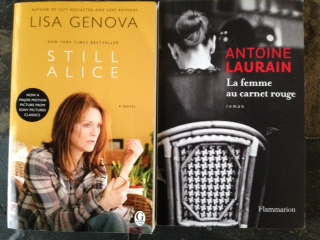
Still Alice by Lisa Genova
A professor of linguistics in her fifties and her family confront a diagnosis of early-onset Alzheimers.   I could identify with Alice, and asked myself more than once if I would pass the memory test her doctor uses to test Alice’s memory.  Could I, after five minutes or so,  recall and restate the name, occupation, and address of an arbitary person with no significance in my life at all, given to me only orally?  The answer to that question has frightened me since I read the book and saw the movie.  Julianne Moore won an Oscar for her portrayal of Alice.  In the novel, Alice’s agency with respect to her illness builds hope and meaning for herself and others afflicted with the disease; the movie, though, ends gripped in stark reality.  Read and view with caution.

12 Rose St. and One Fine Day You’re Going to Die by Gail Bowen
A masterful storyteller who creates memorable and complex characters involved in unpredictable intrigue, Regina’s Gail Bowen is always a good read.  I look forward to the ongoing events in the life of her heroine, Joann Kilbourn.

The Cellist of Sarajevo by Steven Gallagher
A senior teacher of English I met in a workshop I facilitated recommended this book to me, and it did not disappoint.  After twenty-two people in a bread line in Sarajevo die in a mortar shell attack, a cellist performs the same piece of music in the square every afternoon, despite the real threat of death by sniper, to honor each of the victims.  The story is even more relevant in the current political context, as we witness virulent polarization of ideas, and as people value their individual ideologies more than solutions and the good of their country.   See my piece on this novel from October 2015.

All American Boys by Jason Reynolds and Brendan Kiely
This American young adult novel takes up the racial issues that arise when a white police officer assaults Rashad, an African-American youth he (unjustly) suspects of shoplifting.   Quinn, a member of Rashad’s basketball team,  becomes involved when he witnesses the beating and realizes that the police officer is his best friend’s big brother.

All the Light We Cannot See by Anthony Doer
This Pulitzer-prize winner recounts the story of a blind Jewish girl in Nazi-occupied France.  Yes, the story is captivating; it’s the language, however, that mesmerizes me.  Example:  “His voice is low and soft, a piece of silk you might keep in a drawer and pull out only on rare occasions, just to feel it between your fingers.”

La femme au carnet rouge (The Red Notebook) by Antoine Laurain
When I saw the title recommended in an email from Kobo, I thought I would rather read in French than use a translation.  What a delightful experience!  The language is poetic and original, yet accessible.  What can happen when a woman’s purse is stolen?  This simple plot springboard becomes a complex character study and love story.

Le chapeau de Mittérand (The President’s Hat) by Antoine Laurain
French author Antoine Laurain once more weaves an insightful tale about human motivation and the factors that support achievement.  What if you found yourself in a restaurant booth across from François Mittérand (president of France 1981 – 1995), and the latter forgot his hat when he left?  What if you took the hat?  Another simple premise drives a very intricate tale.

I will highight professional reads and non-fiction in the next post.


Tuesday, February 9, 2016

Complementarity

The doorbell rings at my daughter’s, one morning the week of her wedding.  I answer the door because I am nearest the door, it’s the week before a wedding, and no one stands on ceremony.  Two women with pamphlets in their hands greet me, one on the step and one on the sidewalk just below her.   I can tell right away why  they are here, and, I know that, in about ten seconds, I will need to decide whether I will answer their question or send them away.  I open my mouth and take a breath to send them away when I hear the question.

“Has science replaced the Bible?  What can we do about science questioning the existence of God?”

That’s when I pause for second, and seize the opportunity to climb on my favorite soapbox.

”I’ve always seen science as a revelation of God,” I respond.  ”In my view, God has endowed humanity with the gifts that have produced the discoveries and inventions of science.   Look at how science has improved our life over the centuries,  in health, communication, and transportation, just for starters.   Why should God not work through scientists and other people to make His Kingdom come?”

The challenges that science has presented Christianity through the ages (see Copernicus, Galileo, Darwin, reproductive technologies, for example) persist in our own (see Darwin, reproductive technologies).  I write in the Christian context because that’s what I know,  although I suspect that generalization to religion might not be out of line.  Why is it that Christianity interprets advancement through science in our time as such a threat?  Can religion not hold its own?  For religion to tout human progress through science in our time as indicators of the ongoing revelation of God,  though, it would first have to admit that  divine revelation continues through people, exceptional and ordinary, well-known and obscure, embodied through Jesus two thousand and more years ago, and the prophets centuries more before that.    It would have to curb a longing for the thought processes and standards of the Middle Ages and undo any moves already initiated in that direction.  It would have to stop perceiving revelation as having stopped centuries ago.  For me, that’s not such a leap.  It seems perfectly natural.  

Can scientific discoveries can have unforeseen and unwanted negative consequences?  Of course.   Examples abound:  nuclear energy, the internal combustion engine, the technologies that support social media, pesticides, genetic engineering, to name only a few.  Still, the nefarious effects don’t negate the benefits those same discoveries have brought the human race over time.  The arrival of the internal combustion engine, for example, a contributor to greenhouse gases in our age, was perceived as a salvation by early twentieth century cities wondering what to do about the serious problem of disposal of accumulated horse manure (see Steven D. Levitt and Stephen J. Dubner in  SuperFreakonomics: Global Cooling, Patriotic Prostitutes, and Why Suicide Bombers Should Buy Life Insurance).   Genetic engineering created wheat strains adapted to the rigors and growing season of the Canadian prairies.   Benefits and challenges go hand in hand.

Art, it seems, hasn’t suffered the same stigma as religion.   Although art, long perceived as a revelation of God (see for example, Bernini, Michaelangelo, da Vinci, Milton, Dante, Bach, Mozart, Handel), has challenged religious beliefs and practices as well (see The Last Temptation of Christ,  Charlie Hebdo, The Simpsons, South Park, Da Vinci Code), individuals still look to song, music, and visual art to express their sense of God or to discover it.  Why, then, stigmatize science?

It’s time for us to see God revealed in scientific expressions through the ages and in modern times as much as in artistic expressions.  After all, scientific and artistic discoveries and creations are possible because of the gift with which God endowed the human person, created, as Christians believe, in His own image.  Then,  we can say with the lady at the bottom of the steps at my daughter’s that day, “I hadn’t look at it like that before,”  and we can rejoice and be grateful for  accomplishment of all kinds in our own time.  


Saturday, January 9, 2016

Resolution

 I wonder why we think about “today’s world” largely in the negative.     The phrase itself, “in today’s world,” seems to suggest some kind of condemnation.  “In today’s world, young people feel entitled,” I read on Facebok.  Just a few hours later, in conversation,  I hear,  “In today’s world, people are so impolite.”    

Why are we  so negative with respect to our own time?  Why are we prone to generalize about the shortcomings of the world in which we are so blessed to live?  No one in the past ever felt entitled?  The aristocrats of 18th century France come to mind, and they paid a very heavy price.   Were people not impolite in the past?  Socrates thought they were.  He complained about the youth of his time: "The children now love luxury. They have bad manners, contempt for authority; they show disrespect for elders and love chatter in place of exercise."  It seems that both rudeness and entitlement were problems in the fourth century BCE.  

What would happen if, instead,  we used the phrase, “in today’s world” to list the gifts of our own time?  Let’s try it.

·      In today’s world,  society is making progress against crime.  The homicide rate in Canada has fallen to 1.44 victims per 100, 000 population, the lowest rate since 1966, according to Statistics Canada.

·      In today’s world, a political party can win an election against all odds without using attack ads (see Liberal Party of Canada, 2015 general election campaign).

·      In today’s world,  I can stay in touch with friends more easily because of technology.

·      In today’s world, ordinary people give hundreds of dollars to help people they don’t even know.

·      In today’s world,  poverty rates are falling.  The UN's latest development report states that poverty reduction drives in the developing world are exceeding all expectations. It says: "The world is witnessing a epochal 'global rebalancing' with higher growth in at least 40 poor countries helping lift hundreds of millions out of poverty and into a new 'global middle class'. Never in history have the living conditions and prospects of so many people changed so dramatically and so fast."  

·      In today’s world, wars kill fewer people, slightly up from 2005, but down from the early 1970’s, and way down from the 1940’s.  

·      In today’s world, it is no longer a crime to be a homosexual.

·      In today’s world, 86% of children in the world are immunized from polio and diphtheria. 

·      In today’s world, First Nations people can vote (only since 1960!).

·      In today’s world, more women have control over their own lives than ever before.


·      In today’s world, thanks to Internet and Smartboards, a teacher can bring the world to the classroom.  No more ordering films six months in advance, or ordering books for a classroom project from the provincial library to supplement the school library collection.

Are there issues in our world that need work?  Of course.  There have always been.   The question is, why are we so  nostalgic for a past that seems better to us, maybe even ideal, a golden age.  I’ve often wondered what golden age people would want for their own lifetime?  How would it possible to avoid genocide, famine, war, assassinations, dictatorships, apartheid, economic depressions, natural disasters, disease, witch hunts of all kinds, revolution, inquisitions, bad government, discrimination, forced marriages, religious persecution, poor houses, child labour?  As for me and my house, we will take our own era, with all its challenges and its blessings.  

That’s why, although I never make New Year’s resolutions, I think 2016 is a great year to break my resolve.   This year, I propose to use the phrase “in today’s world”  to praise and publicize the good in our world rather than to denigrate any of its inhabitants or conditions.

New Year’s resolution for 2016: 
Use the phrase “in today’s world” to point out the good and the goodness of our era.


Wednesday, December 30, 2015

Periphery

I have to get out of the store.  If I don’t, my integrity will succomb to the pre-Christmas sale at Pier Imports.  Maybe the poinsetta tableware with gold edges, or the cushions embroidered with a red, green, and gold Merry Christmas.  Why not a burlap angel to add to my collection, or a table centre, or another seasonal runner to alternate with the decades old model I purchased in the Christmas store in Chemainus, British Columbia, in 1987.  Scented candles would be nice, in tall, staggered holders as sentinels next to the fireplace.  Why don’t I have these things, I wonder.  Surely, I must need them to have a great Christmas. 

“I have to get out,” I tell my husband, who looks relieved.  “Otherwise, I’ll buy something I don’t need.”  Almost suffocated in the density of Christmas, I head to the till with the object that drew me to the store in the first place,  a Christmas card holder (well, a photo holder, actually), not the original reindeer floor model I saw at a colleague’s home a few days before, with filigreed antlers that pinned  Christmas card artistry, but a workable wall-mounted alternative that I could use year round.  Less of a conversation piece, but practical, without storage challenges.  Outside, on the store steps, gulping the preternaturally balmy air on a December day in Saskatchewan with temperatures above freezing,  I realize that my own Christmas essentials do not much resemble the look in the store. 

In the spirit of year-end lists, then, the keys to my Christmas are :

·      making music, mostly for liturgy, with unbelievable musicians and singers, over the decades, including my husband and my children; now, I make music on the harp, too!

·      family close, on the years that we can all be together, and on the off years, closeness in spirit always;

·      Christmas spirit that imbues the entire year;  like summer, Christmas is also a state of mind and spirit that can permeate our actions and thoughts every single day;

·      contact with friends far away through cards, email, social media; one of the gifts of technology is the ease of keeping in touch with people who mean so much to us, but live far away;

·      a pretty table, with seasonal linens, a table centre, candles, my forty-year old  china 
      and my mother’s silver;

·      comfort food, pared down to the core items and each person’s favorites:  crêpes, tourtière (now handed down to my daughter, who prepares it better than I do), salmon mousse, my mother’s butter tarts, my daughter’s birthday trifle,  turkey with my mother’s meat stuffing and gravy, and, just recently, an addition—chocolate mascarpone crêpes with cherry sauce.

·      games that can involve everyone, no matter what their predilections might be, when the joy of playing eclipses winning or losing, especially laughing with our adult children until our bellies hurt as they reconstruct a game our son and his friends developed more than a decade ago;

·      the timelessness of Christmas, as weekdays crumble like dry cookies and hours meld in delight especially during

·      the interval between Christmas and New Year, reserved for visits, hours on the harp or with books, and, always, the writing, with a fire and tree lights in the background.

That December day, engulfed in the periphery of Christmas,  the reminder of the essence of the season for me anchors me.  I share that experience with you, and thank you for reading.     

Saturday, December 12, 2015

Firsts

Until I heard the Canada Talks radio host introduce end of the year lists last week on the road trip home,  I had let the above zero temperatures, the bare fields and the patches of grass on the lawn seduce me into eternal fall.  Six centimetres of snow the other day ended those delusions.   The end of the year approaches, along with  totals, summaries, syntheses, and rankings of all kinds.  I got to thinking, what would be some of my year-end lists or rankings for 2015?

Let’s start with first-time experiences.  Without ranking,

·      I was the mother-of-the-bride.
·      I spent entire work days with my grandson.
·      I am connected to a person who has ties to an Oscar-shortlisted animation.  Julian Beutel composed and produced the score for animator Seth Boyden’s short animation, “An Object at Rest,” shortlisted for an Oscar in the animated shorts category.
·      I attended the Grey Cup.
·      I received remuneration for a piece of original writing.
·      I gave my first ever public performance on the harp.
·      I endorsed a political candidate with a sign on my lawn.

One might say, “So what?”   Well, my firsts point to my hopes for getting older.

·      A deeper connection to family.  We live a ten-hour drive from our grandson, so we see him only every five or six weeks.  The privilege of spending entire days with him over a stretch of more than a week enabled us to strengthen any bond we have already established.  Family, always the cornerstone of life, has never been more important.  Being with our children brings unparalleled joy, as did the week we spent at our daughter’s before her wedding.  Beyond pride in our children and pure gladness in their presence, we are caught up in a generational shift in the role of supportive older people we once associated with our own parents.  Now, it’s our turn.  For a time, as we age, we are free to be useful.  

·      Links to a world I don’t know a lot about.  Although I love football, I’m not a sports enthusiast, and I had never been to a Grey Cup game before the children surprised me for my birthday.  I needed to consult experienced friends to learn how to dress for an outdoor football game in Winnipeg at the end of November.  Now, I have more of an insider perspective that will help me understand future championship games, whether or not I ever get to return in person:  the challenges the players face, anticipation in the stands, the social fans, the minute organization.

·      Validation of initiatives in my life.   The lawn sign is only the beginning of a new level of political involvement.  Writing will be invaluable to that end, to add to points of view already in play.  Through writing, another passion whose layers I peel away, my knowledge, perspectives, and experience in both the personal and professional realms are accessible to others.

·      Life-long learning.  We are never too old to learn.  In fact, learning might be easier as we age.  For one thing, we have so much prior knowledge and experience to bring to new skills.  For another, we are able to shake off awareness of what other people think like drops of rain from a coat.  So it is with me and my harp—the thrill of a new skill, and the excitement to share it without fear.

These 2015 firsts are, I hope, predictors of what I might be able to build in the years ahead—support for other people, especially family; windows into worlds and perspectives; engagement in issues affecting my community; and a deliberate decision to continue to learn and take risks.  Oh, my!  I have as much potential as a retired person as I did at twenty!


Saturday, November 21, 2015

Action

I know that I cannot express my thoughts on the attacks in Paris one week ago more eloquently than many who have already spoken.  How much more simply and honestly can fear be expressed and then reconciled than in the conversation between Angel Le and his son?  How much more determination and grief can be conveyed than in the letter to ISIS of Antoine Leiris, who lost his wife at Bataclan?   Still, I am compelled to go on record.

Like the rest of the world, I have been appalled and grief-stricken.  What could ever spur any human being to execute scores of innocent people defies any explanation I can find.  Religious zeal, feigned or real, cannot account for it.  Nor can idealogical indoctrination explain acts that display the worst in humanity.  Left with incomprehension, I am trying to sift through the commentaires as well as the emotions, the values, the information and the misinformation shrouded therein.  Responses fall into three categories.

On one front, I hear aggression.  More violence.  French President François Hollande says France is at war.  His words remind me of the “war on terror” George W. Bush declared after the 9/11 attacks of 2001.  Fourteen years later, that war continues.   

In response to terrorist acts like the murders in Paris,  some individuals have opted to circle the wagons.  If suicide bombers killed Parisians, some conclude, then Syrian refugees are suspect, and immigration needs to be curtailed, if not stopped altogether.  Thirty-one American states will refuse refuge to Syrians.  Saskatchewan Premier Brad Wall has called on Prime Minister Trudeau to “suspend your current plan to bring 25 000 Syrian refugees to Canada by the end of the year” and indicates that “Saskatchewan will be fully supportive of any delays in resettling Syrian refugees in order to ensure appropriate screening and security checks.”    Yet, two of the attackers are from Belgium, three from France, and one is a French resident of Belgium.   One may be a Syrian—a Syrian passport, yet to be authenticated,  was found next to his body.    The association of Syrians with terrorists contributes to xenophobia, however unwittingly.    In Canada, a mosque was set afire in Peterborough, and a Muslim woman attacked in Toronto.   Aggression elicits aggression in an infinite cycle of violence.

In contrast, rather than fear, I see courage and hope.  Parisians continue to frequent sidewalk cafés, and gather in public places.  A father tells his son that peace prevails:  terrorists might have guns, but others have flowers and candles.  In Regina, seventy-five people demonstrate in front of the Saskatchewan legislature in support of Syrian refugees.  A couple scales down their wedding so they can help strangers.   Calgary mayor Nenshi says the city is ready to accept up to 2 300 refugees.   Community and religious organizations moblilize to welcome groups of refugees in their midst.  These people refuse to allow the violence of deranged individuals to compromise their own values and ideals.  They refuse to become what they despise.    They realize that self-imposed restrictions on their way of life and their view of the world as a result of terror play right into the hands of ISIS, as Adam Taylor of the Washington Post writes in his column.  Like Antoine Leiris, they refuse to give ISIS that satisfaction.

Just yesterday, in a novel and lucid analysis on “Q”, Samira Ouadi, a Parisian social scientist, expressed her own views on terrorism.  She is particularly focused on the common traits of jihadists.  Not Islam, she says, nor culture.  Youth, she emphasizes.  The jidhadists are all young, very young.  The question, she says, is this:  “What are we doing to our youth so that a part of it feels that, to express its identity, it has to go that far?”   Disaffected youth, she suggests, neglected by their own societies, seek a future in terrorist groups.  Jihad is the new drug culture.

Out of all these sometimes disparate thoughts, a few things are clear.  I, too, must act.  So far, I have allowed my work as a teacher and my investment in my children to carry my duty to society.  Now, though, as a retired person, I must do more.  What can “more” look like?

·      Continue to invest in people:    youth, people in my own community facing challenges, and the refugee from abroad. 

·      Speak out.  Provide a perspective, share information, point out fallacies, remind myself and others of essential truths as I perceive them, whether  people agree or not.

·      Stay the course.  Choose trust tempered with awareness, not naiveté.  Be kind.  Be inclusive.  Stick to my travel plans.  Refuse to become hateful, or vengeful, or suspicious as a result of actions whose purpose is exactly to make me hateful, vengeful, and suspicious, and to use examples of that hate, vengeance and suspicion as evidence to support horror.

I have a voice.  I have time.  I have abilities.  To be on record, my actions must complement my words.